


October 4, 2002
China: The more things change, the more they stay the same
A recent Reuters press release announced that traders were expecting China to continue exporting corn at the rate of 40 million bushels a month through the end of the first quarter of the next calendar year. In all, it is expected that China will export in excess of 390-430 million bushels during 2002.
China is capitalizing on a good corn harvest this year that will yield about 5 billion bushels, compared to an expected U.S. crop in the range of 8.5-8.8 billion bushels. In addition to a good harvest China has a large carryover supply of corn giving it some additional flexibility to capture the higher prices brought about by a short crop in the United States.
All of this brings us back to a column we wrote in December of 2000. In that column we compared the 1996 estimations of crop forecasters who expected that China would be importing 536 million bushels during the 2002 crop year. Instead it looks like they will be exporting 311 million bushels (see figure 1), a difference of nearly 850 million bushels. By 1999, the forecasters had revised their estimation of the Chinese corn trade downward, expecting China to export 95 million bushels, some 216 million bushels smaller than the current export expectation.
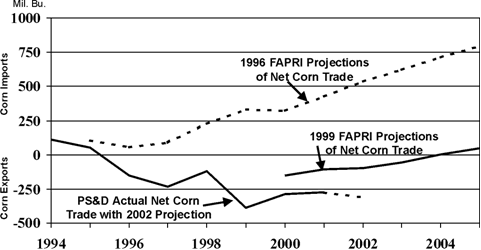
Figure 1. Chinese Corn Trade - A comparison of 1996 FAPRI projections with actual data for 1996-2001, with 2002 PS&D projection, and 1999 FAPRI projections for 2001 to 2005.
Why were the expectations for Chinese imports so high in 1996 and even somewhat optimistic in 1999? With a growing middle class in China and increasing personal income many analysts in the 1990s expected that the demand for meat and eggs would increase as this emerging middle class shifted from a diet heavily dependent on grain to a diet that included additional meat. The reasoning went like this, "With 1.3 billion people in China, if each person on average ate just one dozen more eggs a year, think what that would mean for corn demand and U.S. exports of corn."
That reminds me of a quote that APAC colleague Harwood Schaffer recently found in the book "The Farmer's Last Frontier Agriculture 1860-1897" by Fred A. Shannon. It is a part of The Economic History of the United States series. Shannon writes, "Since the South would not solve the problem [surplus cotton production] by cooperative methods [read: acreage reduction program], there was probably as much irony as humor in Ambassador Wu T'ing-fang's remark, before a group of Southern manufacturers, that the surplus problem could be solved if each man in China would add just one inch to the length of his shirt." This remark by Wu T'ing-fang was made at the turn of the 20th century.
It seems that not much has changed in the last one hundred years. Simply multiplying the population of China times some implied per capita increase in number of pounds of corn required to provide each person in China a few extra pounds of meat or eggs cause farmers to have visions of dollar signs dancing in their heads. But, as history tells us, simply doing the math does not cause, nor always foretell, an actual increase in demand for U.S. products.
Daryll E. Ray holds the Blasingame Chair of Excellence in Agricultural Policy, Institute of Agriculture, University of Tennessee, and is the Director of the UT's Agricultural Policy Analysis Center. (865) 974-7407; Fax: (865) 974-7298; dray@utk.edu; http://www.agpolicy.org.
Reproduction Permission Granted with:
1) Full attribution to Daryll E. Ray and the Agricultural Policy Analysis Center, University of Tennessee, Knoxville, TN;
2) An email sent to hdschaffer@utk.edu indicating how often you intend on running Dr. Ray's column and your total circulation. Also, please send one copy of the first issue with Dr. Ray's column in it to Harwood Schaffer, Agricultural Policy Analysis Center, 310 Morgan Hall, Knoxville, TN 37996-4500.