


October 17, 2002
Subsidies II: Exploding production south of the equator
Shortly after I finished writing last week's column on subsidies and crop prices, I read a soybean-related press release that reinforces the idea that the level of U.S. subsidies, while a problem perhaps, is not the main reason crop prices are low world-wide.
In last week's column I argued that the large subsidies received by U.S. crop producers, when viewed in the context of agricultural policy changes, can be seen not as the cause of low prices but rather as the consequence of policy changes contained in the 1996 Farm Bill. The increase in U.S. production and low prices in the 1996-2001 period are partly the result of the decision to end production controls, releasing for production acreage that had previously been set-aside by short-term acreage control programs. The other change that had a significant impact on prices was the elimination of the non-recourse loan which had allowed CCC stocks to serve as a price buffer for the marketplace.
As reported in an October 9, 2002 Reuters story, Alberto Tepedino, finance director of the Brazilian railroad company, Brasil Ferrovias SA, said that one of the factors behind rising U.S. subsidies is the rapidly increasing production in Brazil and Argentina. With a lower cost of production due primarily to land and labor costs, South American soybean producers have rapidly moved from being inconsequential exporters to the point where, together, they account for nearly one-half of world exports.
The major cost disadvantage faced by Brazilian soybean producers has long been the cost of transporting the beans from the field to an Atlantic port. Tepedino's Ferronorte rail line which runs through the middle of the major soybean producing area has been extended to Alto Araguaia. This recent rail extension will reduce transportation costs by 30 percent for producers in the area around Alto Araguaia making them even more price competitive in the world market.
Tepedino says that the soybean output gains in South America have kept soybean prices low, even as world demand for soybeans has grown. The veracity of that statement can be seen in Table 1. In the twelve year period from 1990 through 2001, world demand for soybeans grew by 77.2 percent while Argentine and Brazilian production grew by 174.2 and 113.9 percent respectively. By contrast U.S. production grew by 50.3 percent.
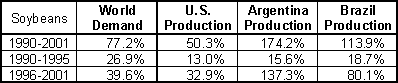
Not only did South American production outpace the U.S. for the whole period it also grew faster during the years in which the 1996 Farm Bill was in effect than in the prior six years. The data provide no indication that the "market driven" approach adopted in the 1996 Farm Bill had any impact on reducing production in Argentina and Brazil. One of the arguments that was used to dismantle the U.S. production control system was, "If we don't produce it, someone else will." From what we can see it quickly becomes apparent that "They will produce it, no matter what we do." Brazil and Argentina have long-term development agendas and using their economic competitive advantage in agricultural production appears to be one of the strategies they are using to achieve their goals. U.S. policies and prices, exchange rates, and a host of other influences may marginally affect the rate of growth of soybean acreage and production in Brazil and Argentina, but basically it's a train that has left the station and it has considerable momentum.
So what does it all mean? In addition to changes in U.S. policy over the last few years, the soybean market has had the added burden of burgeoning production in South America. The combined impact of increased soybean production south of the equator and policy changes that provided planting flexibility, which freed up acreage formerly planted to corn and other program crops for soybeans, and dismantled the price support system have resulted in dramatically reduced soybean prices compared to the mid-1990s. Yes, U.S. subsidy levels have exploded since the late-1990s. But is important to remember the direction of causation: the low prices caused the increase in subsidies, subsidies were not large and then prices fell. Another important point: just as farmers in other countries who do not have subsidy programs have not reduced production materially, neither would farmers in this country reduce production substantially if subsides were lower. Land prices would plummet and some land would change hands but production would continue unabated.
Daryll E. Ray holds the Blasingame Chair of Excellence in Agricultural Policy, Institute of Agriculture, University of Tennessee, and is the Director of the UT's Agricultural Policy Analysis Center. (865) 974-7407; Fax: (865) 974-7298; dray@utk.edu; http://www.agpolicy.org.
Reproduction Permission Granted with:
1) Full attribution to Daryll E. Ray and the Agricultural Policy Analysis Center, University of Tennessee, Knoxville, TN;
2) An email sent to hdschaffer@utk.edu indicating how often you intend on running Dr. Ray's column and your total circulation. Also, please send one copy of the first issue with Dr. Ray's column in it to Harwood Schaffer, Agricultural Policy Analysis Center, 310 Morgan Hall, Knoxville, TN 37996-4500.