


December 27, 2002
Acreage devoted to export production shrinks over last 25 years
In recent statements like one she made on December 11 announcing that the United States and Chile had concluded a free-trade agreement, U.S. Secretary of Agriculture Ann Veneman emphasized the importance of this agreement for U.S farmers and ranchers. She said, "The agreement will give America's farmers and ranchers and the businesses they support improved, and in many cases, new access to a market of 15 million consumers."
For more than one hundred years, agricultural exports have been important to America's farmers and ranchers providing a market that has allowed them to produce more food than can be consumed domestically. Without exports, the ag sector would be considerably smaller than it is today. That being said, we need to remember another lesson that this history has taught us. Exports do not guarantee prosperity. They are not an assured solution to the chronic price and income problems faced by U.S. producers.
When we talk about exports of agricultural crops we need to make sure that we don't overplay the potential and foster unrealistic expectations on the part of producers. Time and time again we have hung our hat on the star of growing exports only to be disappointed.
Let's examine the data with an eye toward what they might mean for the future. In figure 1 we can see that, on average, during the ten years before the 1985 Farm Bill 103.6 million acres were needed to supply the net exports of the 8 major crops that were sold in the international marketplace. The 1985 low of 67 million acres and the decline in exports that those reduced acres represent, were surely one set of the factors that led Congress to adopt export oriented legislation that year.
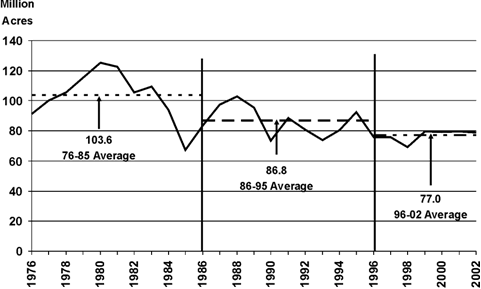
Figure 1. Net U.S. export acreage for eight major crops (corn, soybeans, wheat, grain sorghum, rice, cotton, oats and barley), 1976-2002. Data source: USDA.
Despite the reduction in the loan rate and other efforts to stimulate the export of U.S. crops during the ten years following the adoption of that legislation the acreage required to produce our export crops experienced a 16 percent decline. This is undoubtedly not what the proponents of that bill anticipated.
In the 1996 Farm Bill, Congress again took another shot at making U.S. crops more competitive in the export market by eliminating the price floor under crops instituting the use of Loan Deficiency Payments/Marketing Loan Gains. By using these devices farmers would be assured a minimum price (per unit revenue) while buyers could purchase the crops at world price levels. But instead of increasing the amount of acres needed to produce for exports, the acreage dropped again, averaging 77.0 million acres in the 1996-2001 period.
But what about the straight volume of exports? Figure 2 shows that volume of exports dropped as well. In the ten years before the adoption 1985 Farm Bill, the U.S. exported, net of imports, an average of 122 million metric tons of the 8 major crops (corn, wheat, soybeans, grain sorghum, cotton, rice, oats and barley). In the most recent period the average dropped to 113 million metric tons.
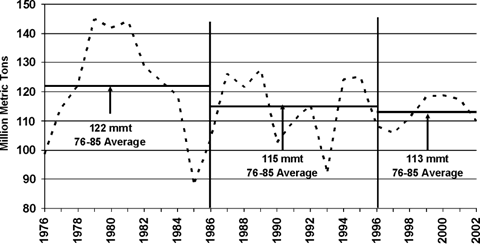
Figure 2. Net U.S. export volume for eight major crops (corn, soybeans, wheat, grain sorghum, rice, cotton, oats and barley), 1976-2002. Data source: USDA.
Exports definitely absorb a significant portion of U.S. crop production. But, despite the upbeat statements by USDA officials and some general farm and commodity organizations, major crop exports have shown no real growth for decades, even though we have spent hundreds of billions of dollars since 1985 in policies designed to expand exports.
It is apparent that non-price factors have dominated the markets suggesting that we could have spent significantly less, allowed farmers to receive more of their income from the marketplace, and still exported nearly the same volume of grains and seeds.
Daryll E. Ray holds the Blasingame Chair of Excellence in Agricultural Policy, Institute of Agriculture, University of Tennessee, and is the Director of the UT's Agricultural Policy Analysis Center. (865) 974-7407; Fax: (865) 974-7298; dray@utk.edu; http://www.agpolicy.org.
Reproduction Permission Granted with:
1) Full attribution to Daryll E. Ray and the Agricultural Policy Analysis Center, University of Tennessee, Knoxville, TN;
2) An email sent to hdschaffer@utk.edu indicating how often you intend on running Dr. Ray's column and your total circulation. Also, please send one copy of the first issue with Dr. Ray's column in it to Harwood Schaffer, Agricultural Policy Analysis Center, 310 Morgan Hall, Knoxville, TN 37996-4500.