


July 11, 2003
Major US export competitor in the distant future: EU? Brazil? It could be China!
Back in April we reported on a USDA Foreign Agricultural Service (FAS) study that conservatively estimated that Brazil could bring an additional 420 million acres into crop production. By way of comparison, U.S. total crop acreage hovers around the 250 million acre figure.
We have already seen the impact of Brazil's entry into the soybean marketplace. As recently as 1970 Brazil exported a mere 8 million bushels of soybeans while the U.S. exported 434 million bushels. For the 2002 crop year it is expected that Brazil will export 764 million bushels of soybeans with the U.S. export level coming in at 1,010 million bushels. This past year, for the first time total soybean exports from Brazil and neighboring Argentina surpassed U.S. exports.
As a major competitor in the export of soybeans, Brazil should not be overlooked. On the other hand a look at the rest of the world suggests that there may be other countries out there who may match or exceed Brazil's recent performance. And key among the possibilities is China. Despite all the hype surrounding China's entry into the World Trade Organization and the positive impact this may have on the prospects for U.S. farm exports, China has the potential to become a major agricultural export competitor.
Corn provides a case in point. At the time of the adoption of the 1996 Farm Bill all major providers of agricultural baseline projections, including FAPRI, saw China's imports of corn on an upward trend (Figure 1). By the 1992 crop year, it was projected that China would be importing 536 million bushels of corn that would be fed to pork and poultry to meet the demand for animal protein by a growing middle class. Current USDA estimates of China's corn trade shows China EXPORTING 531 million bushels of corn. That's a net gap of nearly 1.1 billion (with a "b") bushels of corn. Even in the face of the experience of the last seven years most baseline providers still view China as a potential customer.
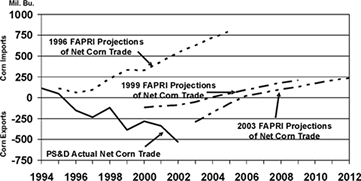
Figure 1. Chinese net corn trade, actual and projections, 1994-2012. Source: USDA PS&D and FAPRI.
The one crop where China is a major customer is soybeans. China's importation of soybeans began an upward trend in 1995 zooming to 624 million bushels for the 2002 crop year. Will this trend continue or is China simply using soybean imports to build up its crush capacity in preparation for an increased level of domestic soybean production? Only time will tell, but given the developments taking place in Chinese agriculture, I would not want to bet the farm on China remaining an importer of soybeans.
As I have reported in other columns, Chinese researchers report cutting edge research in crop genetics, including a variety of crops that can be grown on arid, alkali soils while achieving impressive yields. If that research pans out in field trial it could open up a reported 250 million acres of land in western China to agricultural production.
In eastern China, policies are being put into place to encourage rural development so that the number of people working the land can be reduced. This will allow for the introduction of U.S. style production agriculture in areas that have been dominated by tiny family plots.
The level of investment in China by transnational agribusinesses continues to increase with all the major firms establishing facilities there. The technology that has been responsible for the growth of agricultural production in the U.S. is quickly being transferred to China by firms like Cargill and John Deere. In addition the Chinese are improving their satellite mapping and imaging capability, so that they will be able to apply the benefits of precision agriculture to their fields.
Given all this, I would not be surprised if over the next 20 to 30 years, China emerges as the major player in the international grain trade. China may even surpass Brazil, Canada, Australia and the EU as a major competitor to the U.S. China, after all, has both the land and the human resources necessary to get this done.
Daryll E. Ray holds the Blasingame Chair of Excellence in Agricultural Policy, Institute of Agriculture, University of Tennessee, and is the Director of UT's Agricultural Policy Analysis Center. (865) 974-7407; Fax: (865) 974-7298; dray@utk.edu; http://www.agpolicy.org.
Reproduction Permission Granted with:
1) Full attribution to Daryll E. Ray and the Agricultural Policy Analysis Center, University of Tennessee, Knoxville, TN;
2) An email sent to hdschaffer@utk.edu indicating how often you intend on running Dr. Ray's column and your total circulation. Also, please send one copy of the first issue with Dr. Ray's column in it to Harwood Schaffer, Agricultural Policy Analysis Center, 310 Morgan Hall, Knoxville, TN 37996-4519.