


Asian Crisis Revisited
Discussion of what should be in the 2007 Farm Bill has resurrected a debate that had abated as US crop prices improved during the 2002 and 2003 crop years. One recurring argument is that the low crop prices of the 1998-2001 time period was due to the Asian Crisis. The argument is that the Asian Financial Crisis, which began in the summer of 1997 with the collapse of the Thai currency triggered a decline in world demand for grains and seeds resulting in the low crop prices that plagued farmers for four years.
During one of our frequent excursions into the depths of agricultural data, we noticed that world demand for crops increased – not decreased – the 1997-2001 years. Specifically we then explored the question of what happened to 15 grain and oilseed complex demand (wheat, corn, rice, sorghum, oats, rye, barley, millet, soybeans, peanuts, cottonseed, rapeseed/canola, sunflower, copra, and palm kernel) by looking at the years between 1990 and 2004 (figure 1). A look at total world demand for the 15 grains and oilseed complexes shows that demand increased in every year since 1990, with the exception of 1995 when prices skyrocketed on limited supplies.
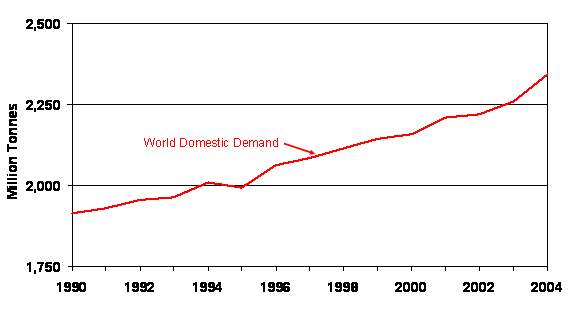
Figure 1. World domestic demand for 15 grains and oilseed complexes (wheat, corn, rice, sorghum, oats, rye, barley, millet, soybeans, peanuts, cottonseed, rapeseed/canola, sunflower, copra, and palm kernel), 1990-2005. Units are in million tonnes (metric tons). Source: USDA, PS&D.
Figure 2 shows that in the 1997, 1998, and 1999 crop year world export demand for the 15 crops increased from the previous year. US exports of the 15 grain and oilseed complexes, on the other hand, declined in 1997 and then increased in 1998, 1999 and 2000, hardly the picture painted by those who blamed low prices on reduced world demand. Export demand for seeds and grains increased in the first three low price years (1998, 1999 and 2000) that sent LDP/MLG payments through the roof and farmers to Congress arguing for emergency payments.
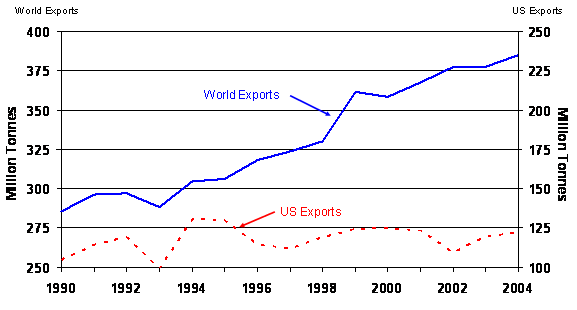
Figure 2. US and world exports of 15 grains and oilseed complexes (wheat, corn, rice, sorghum, oats, rye, barley, millet, soybeans, peanuts, cottonseed, rapeseed/canola, sunflower, copra, and palm kernel), 1990-2005. Note: US exports are graphed on the right hand axis. Both the left and right hand axes have non-zero minima but the scale is the same for both allowing for meaningful comparison. Source: USDA, PS&D.
While it has become conventional wisdom to blame the low prices of the 1998-2001 period on the Asian Crisis, the data suggest that we need to look elsewhere for an explanation. We would argue that the explanation lies in the 1996 Farm Bill policy changes that eliminated any semblance of supply management and floor prices for major crops.
Daryll E. Ray holds the Blasingame Chair of Excellence in Agricultural Policy, Institute of Agriculture, University of Tennessee, and is the Director of UT’s Agricultural Policy Analysis Center (APAC). (865) 974-7407; Fax: (865) 974-7298; dray@utk.edu; http://www.agpolicy.org. Daryll Ray’s column is written with the research and assistance of Harwood D. Schaffer, Research Associate with APAC.
Reproduction Permission Granted with:
1) Full attribution to Daryll E. Ray and the Agricultural Policy Analysis Center, University of Tennessee, Knoxville, TN;
2) An email sent to hdschaffer@utk.edu indicating how often you intend on running Dr. Ray’s column and your total circulation. Also, please send one copy of the first issue with Dr. Ray’s column in it to Harwood Schaffer, Agricultural Policy Analysis Center, 310 Morgan Hall, Knoxville, TN 37996-4519.